
FAQs
Who Should Invest?
This opportunity is ideal for investors who are passionate about real estate and interested in:
- Not wanting to be a landlord, but interested in the benefits that real estate investment offers.
- Investing in the Canadian real estate market, passively.
- Generating wealth through real estate development.
- Leveraging those with more experience to find, fund and manage the investments.
- Diversifying your portfolio beyond active real estate, stocks, bonds and mutual funds.
- Spreading your investments across multiple projects.
- Using Registered Funds (RRSP, RIF, LIRA, LIF, TFSA) to invest in real estate.
What is an MFT?
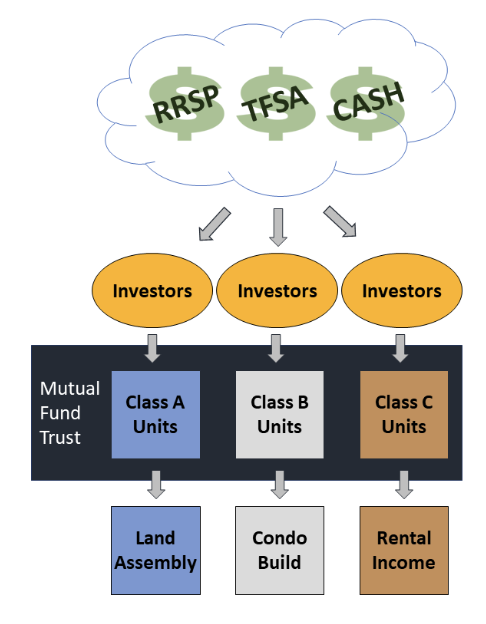
It is a business structure to assist in raising investment capital and providing secure, dependable tax savings for both investors and developers. Our PHDMFT allows us to raise capital for multiple projects using only one MFT structure while isolating one project from another. MFTs allow investors to use their registered funds like RRSPs and TFSAs to invest into Private Equity Real Estate Opportunities that they may not have otherwise had the ability to participate in individually.
The PHDMFT (Paul Hecht Developments Mutual Fund Trust) specifically invests in private residential development projects. The Fund takes an ownership stake in the underlying projects with the Developer or Builder, and invests in the creation of new housing – condo development and/or purpose-built rentals. The Fund then shares in the profitability of the projects with its investors as a return, either through a debt offering or an equity offering, or a combination of both.
Why is it attractive to invest into an MFT?
Every year Canadians contribute over $50 billion into RRSPs alone while the total value of TFSAs is close to $300 billion (source: StatsCan – 2020). Investors want to us their registered funds because many times, this is their only source of investment capital and when they receive income from their registered investments, they are either tax deferred (RRSP) or tax free (TFSA). MFTs are one of the most tax-efficient structures available, which means that cash (non-registered) investors still benefit from the flow-through nature of the MFT. For example, capital gains (low tax rate) are passed from the project through the MFT to the cash investor as capital gains.
What does a typical MFT structure look like?
What is Private Equity?
A non publicly traded investment, not on the public stock market. The majority of investors in private equity funds are Pension Plans, Institutional Investors and high net worth individuals. At PHDMFT, we offer Private Equity investments via Private Real Estate to Non Institutional investors.
Who regulates Private Equity Investments?
Canada has no securities regulatory authority at the federal government level. Instead, each province and territory has a securities commission or equivalent authority and legislation. The Canadian Securities Administrations (CSA) is an umbrella regulatory organization that serves Canadian markets, securities issuers, and investors. The CSA coordinates and harmonizes securities regulation that is enforced individually by Canada’s 10 provinces and 3 territories.
Who can Invest in Private Equity?
There are certain eligibility requirements that each individual or entity must meet. Generally speaking, one must either be and Accredited Investor or a Non-Accredited Investor. Most Offerings allow specific Exemptions, based on the the type of Offering for each individual project. Some projects can only accept Accredited Investors, while other are able to accept Non-Accredited investors.
What is an Accredited Investor?
An Accredited investor in Canada is an individual or entity that meets specific standards set by the Canadian Securities Administration (CSA), qualifying them to partake in specific private securities offerings that are not listed on a public stock market. Generally speaking, an Accredited Investor should have a net worth exceeding $1 million, either individually or jointly with a spouse. This amount cannot include a primary residence.
What is a Non-Accredited Investor?
Anyone can buy securities under this Exemption, but there are limits depending on whether they are an Eligible or Non-eligible investor. An Eligible investor, must have at least one of the following: (a) a person whose (i) net assets, alone or with a spouse, in the case of an individual, exceed $400,000, (ii) net income before taxes exceeded $75,000 in each of the 2 most recent calendar years and who reasonably expects to exceed that income level in the current calendar year, or via other allowable Exemptions, such as, a person described in section 2.5 [Family, friends and business associates]. This for general information only as each province and each Offering have different requirements which may apply to your specific situation. It is best to have a conversation with our team to discuss these potential scenarios.

